NSG3024 Fundamentals of Nursing Skills Lab Week 5 guide
A source-bounded manual for the real registered Week: capture its identity, map its rubric, complete the permitted work, verify delivery, and carry feedback forward.
The official calendar supports this 11-week course context. It does not publish a universal topic or assessment for NSG3024 Week 5. The registered Brightspace shell is authoritative for the exact work.
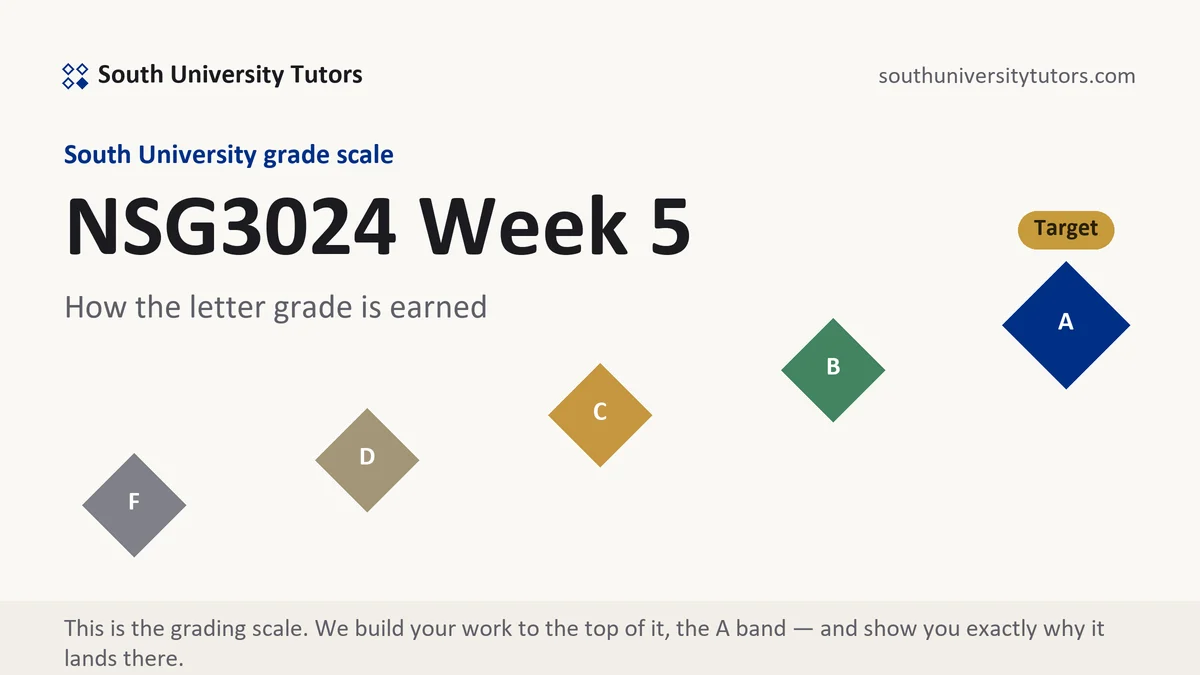
Capture the live Week identity
Record the exact Week heading, assessment or discussion title, type, directions, point value or weight, rubric version, template, permitted sources and tools, deadline and time zone, file type, and submission location. Preserve any announcement that changes a requirement. Do not rely on a prior section or a public calendar for assignment identity.
Separate every obligation into its own row: initial discussion, peer replies, paper, case, calculation, quiz, presentation, project step, lab, simulation, group dependency, practicum document, clinical task, or exam-preparation block. A Week position can contain several completion tests.
Mark prerequisite work before production begins. Required reading, data access, site or preceptor confirmation, group input, instructor approval, template download, or earlier project feedback can determine whether the Week is actually ready to draft.
Convert the rubric into acceptance tests
Rewrite every row as a yes-or-no test. Identify the action verb, required concept or decision, evidence, example or application, calculation or visual, destination, and top-band condition. Highlight “all,” “each,” “compare,” “analyze,” “evaluate,” and “justify”; each word changes what complete means.
Directions and rubric remain separate contracts. The directions control scenario, audience, length, format, source limits, tools, and submission. The rubric controls scoring. If they conflict, pause and obtain clarification rather than silently choosing the easier interpretation.
Build a criterion-to-section map before writing. Every rubric row needs a visible home. Every major paragraph, table, slide, calculation, or appendix should earn its space by satisfying a named requirement.
Reading the rubric row by row at the halfway mark
At the midpoint it pays to read the rubric backwards, starting from the final row. Closing rows are typically mechanics, format, and citation, and reading them first while you still have drafting time available is the cheapest points recovery on offer. With those constraints already fixed in the template, you can work upward into the reasoning rows without a formatting question interrupting the thinking.
Compare this rubric against the two or three you have already worked through and identify your personal weak row. Nearly everyone has one: a criterion type that keeps costing points across otherwise unrelated assignments. Name it out loud, write the single specific test that would have caught it each time, and run that test on this draft before you run any other check.
Then look hard at what the top band asks for that the band below it does not, and ask whether your outline produces that difference anywhere at all. If your plan would yield a competent middle-band answer even executed perfectly, the plan is the problem rather than the prose. Change it now, while changing it costs an hour of restructuring instead of a rewrite the night before the deadline.
Produce the Week 5 work
Begin with the purpose, answer, or decision the prompt actually requires. Organize by rubric logic, not by the order in which ideas occurred. Connect claims to evidence and explain why that evidence matters in the specific scenario. Label assumptions and keep facts, interpretation, and recommendation distinct.
For discussions, answer the prompt directly, add permitted evidence, apply it, and end with a question or implication that supports substantive peer exchange. For papers and presentations, use headings or slide messages that expose the argument. For calculations, show inputs, units, method, intermediate result, final result, rounding rule, and interpretation.
Clinical, practicum, laboratory, simulation, group, and authenticated actions remain student-performed. Support can explain the concept, help plan de-identified written components, review calculations, rehearse a presentation, or prepare for a proctored exam. It cannot fabricate experience, signatures, attendance, patient facts, or assessment performance.
Week 5 reasoning: writing about wound care without narrating a case
The midpoint of a term is usually where written work stops being a single answer and becomes a small argument with a defended sequence. Wound content is a good vehicle for that shift because order genuinely matters: what is assessed before what is done, what is prepared before what is opened, what is recorded before anything is discarded. When a posted item asks for rationale, write the sequence as a set of dependencies rather than as a list of steps, because dependencies show reasoning and steps only show recall.
Keep descriptive writing and interpretive writing in separate sentences. A description records what is observable. An interpretation states what it means. Rubrics in this content area frequently split those two things across different rows, and a draft that blends them into one fluent sentence can end up satisfying neither. Write the observation, then the inference, then the action the inference supports, and the row boundaries take care of themselves.
Aseptic reasoning deserves its own paragraph in any midpoint draft that touches it. The written question is rarely which technique to select. It is what would constitute a break in technique and what follows from one. A rationale that names the boundary and then names the consequence of crossing it demonstrates the judgment the course is building toward. Whatever the registered Brightspace shell posts remains the authority on the technique and terminology this section teaches.
Building a source ledger you can reuse for the second half
The halfway point is the right moment to stop hunting sources per assignment and start maintaining a ledger. Record the full citation, the specific claim it supports, the publication date, the locator, whether it is primary or secondary, and every place you have already used it. A source reused later in the term without a currency recheck is a quiet risk, and a ledger is the only thing that makes that risk visible before a grader does.
The ledger also fixes the most common attribution failure, which is losing track of what was quoted and what was reworded. Record that status at the moment you capture the material, not at the moment you draft from it, because by then the memory has already blurred. Paraphrase that stays too close to its original is a substantive integrity problem even when the citation is present and correct, and the only reliable prevention is capturing the idea in your own sentences the first time you read it.
Decide now where the ledger lives, because that decision will hold for the rest of the term. A ledger kept in one document on one machine fails the first time you draft somewhere else, and highlights scattered through a reader are not a ledger at all. Keep it in a single place you can reach from anywhere you work, and give every entry a short plain label you would still recognize six weeks from now, since a citation string on its own will not remind you why you kept it. The second half of a term generates more sources than the first, and the organizing choice you make here is the one you will be living with when the closing deadlines arrive.
Verify quality and delivery
Run a requirement pass first: every direction and rubric row is present. Run a reasoning pass: evidence fits the claim, analysis fits the prompt, calculations reproduce, and recommendations follow. Run a consistency pass across prose, tables, figures, slides, appendices, citations, and references.
Finish with the delivery pass: current template, citation style, accessibility, filename, file type, export, links, and rendered upload. Open the final file after export. A correct source document can still fail when a chart clips, a table shifts, a font disappears, or the wrong version uploads.
After submission, record the posted result and feedback. Classify the miss, revise the smallest complete unit if revision is allowed, trace dependent changes, and write one prevention rule for Week 6. Then reconcile the course grade and update the next action.
Three pitfalls at the midpoint
The first is coasting on a method that has been working. Rubrics escalate across a term, and a process calibrated to second-week expectations produces second-week results in the fifth week. The fix is to read the current rubric as though you had never taken this course, deliberately ignoring your memory of what was accepted before, and to plan from what it says rather than from what you expect it to say.
The second is over-reliance on one strong source. A draft where a single reference carries every claim reads as a summary of that reference rather than as your analysis of a question. The fix is to check the ledger for distribution before the final pass and add independent support to any claim currently resting alone on one citation.
The third is losing the thread between observation and recommendation. A midpoint draft that assesses carefully and then recommends generically has broken its own argument in the middle, and graders notice the seam. The fix is a link pass: for every recommendation in the document, point to the earlier sentence that makes it necessary, and if no such sentence exists, either write it or drop the recommendation.