Nursing Specialization in Nurse Educator — Master of Science in Nursing (MSN) program guide
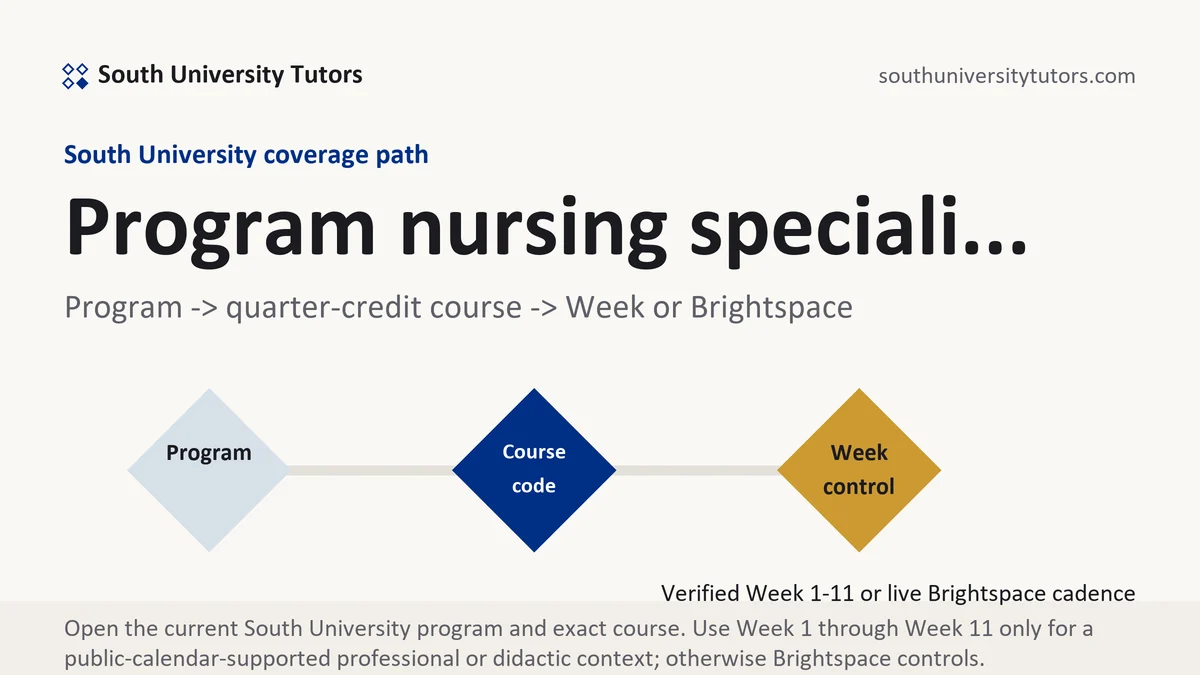
The Capella-style hierarchy adapted to South University: exact program, exact quarter-credit class, then verified Week links or the live-syllabus control point.
This guide wires every unique code printed in the current public curriculum groups for this path. Requirements, alternatives, electives, capstones, practica, clinical courses, and support courses stay under their published headings so a long program is usable rather than flattened.
Current program identity
The current catalog establishes this program identity and curriculum. The registered degree audit controls the individual student's active plan.
The public catalog is the evidence source for program identity, curriculum headings, course codes, titles, and quarter credits. It is not a personal enrollment contract. Location, delivery format, state authorization, catalog version, transfer credit, prior credential, clinical clearance, course availability, and progression policy can change the sequence a registered student actually follows.
Start with the current degree audit. Match each active line to the same code below, preserve alternatives exactly as displayed, and ask an advisor about any mismatch before scheduling or ordering support. A code's presence in a catalog group proves public membership; it does not prove that every student takes it in the same quarter.
The classes, one by one
Open a code for its full class guide, all mapped program contexts, catalog description, Week boundary, rubric workflow, grade controls, and right-side navigation. Shared courses have one canonical page so guidance and links cannot drift between programs.
MSN Core 12 Credits
| Course | Current title | Quarter credits | Manual control |
|---|---|---|---|
| NSG5000 | Role of the Advanced Practice Nurse: Transformational Leadership in Advanced Practice | 4 | Live syllabus |
| NSG6002 | Health Policy and Health Promotion in Advanced Nursing Practice | 4 | Live syllabus |
| NSG6101 | Nursing Research Methods | 4 | Live syllabus |
Specialization in Nurse Educator
| Course | Current title | Quarter credits | Manual control |
|---|---|---|---|
| NSG6003 | Teaching and Learning Strategies in Nursing | 4 | Live syllabus |
| NSG6102 | Evaluation of Educational Outcomes in Nursing | 4 | Live syllabus |
| NSG6103 | Curriculum Design and Evaluation in Nursing Education | 4 | Live syllabus |
| NSG6104 | Pharmacology, Pathophysiology, & Physical Assessment for the Nurse Educator | 6 | Live syllabus |
| NSG6203 | Practicum in Nursing Education I | 4 | Live syllabus |
| NSG6204 | Practicum in Nursing Education II | 4 | Live syllabus |
| NSG6999 | Graduate Project in Nursing | 4 | Live syllabus |
Program → class → Week or live syllabus
South University publicly operates 5-, 10-, and specialized 11-week formats, but this program's public curriculum does not assign one duration to every course. The calendar is not a syllabus. Course pages therefore preserve the registered Brightspace cadence instead of manufacturing universal Week pages.
For every registered class, copy the exact session length, Week labels, start and end dates, due-day pattern, time zone, grading model, late rule, and final-submission window from Brightspace. Then capture the real work beneath each Week: discussion, reply, quiz, paper, case, project step, lab, simulation, practicum record, clinical requirement, or exam-preparation block.
A Week number is a position, not an assessment identity. Before drafting, preserve the exact live title, directions, rubric version, permitted sources and tools, template, point value, file type, and deadline. If an announcement changes any of them, the announcement joins the control packet.
Build the quarter board
Give each obligation one row with course, exact live label, Week or date, due time and time zone, points or weight, prerequisite, evidence need, current status, feedback status, and next action. Separate discussions, written submissions, quantitative work, quizzes, proctored preparation, group dependencies, labs, clinical activity, and practicum documentation. Their completion tests are different.
Work backward from the due time. Reserve intake for reading the shell and rubric, evidence time for sources or data, production time for the actual deliverable, and a final delivery pass for citation, template, accessibility, filename, export, and upload rendering. A five-week class compresses these blocks; it does not eliminate them.
Reconcile after every posted result. Record points earned and possible or the weighted-category result, calculate the remaining path without premature rounding, and note any separate exam-average, clinical, competency, attendance, or progression gate. The next action should be small enough to start immediately.
Turn the live rubric into acceptance tests
Directions and rubric are two contracts. Directions control the scenario, audience, length, format, tools, source limits, and submission rules. The rubric controls the evidence and reasoning that earn credit. Translate each requirement into a yes-or-no test and assign it a destination in the paper, calculation, presentation, care document, project file, or discussion.
Read verbs literally. “Describe” needs accurate coverage; “compare” needs a visible basis; “analyze” needs relationships and implications; “evaluate” needs criteria and a judgment; “recommend” needs a defensible choice tied to evidence. Flag universal words such as “all,” “each,” and “every.” They change the minimum complete response.
Run content QA before delivery QA. First check coverage, logic, evidence quality, calculations, and consistency across prose, tables, figures, slides, and appendices. Then check citation matching, template fields, accessibility, filename, file type, and rendered export. Do not let clean formatting hide a missing decision or let strong analysis fail on the wrong file.
Clinical, exam, and professional boundaries
Students perform patient care, clinical decisions, skills, simulations, laboratory activity, practicum and rotation hours, preceptor communication, signatures, experience logs, group participation, identity-verified activity, and final submission. Protected health, client, employee, and proprietary information must be removed before any tutoring review.
Proctored, standardized, competency, dosage-calculation, readiness, and licensure-related assessments are preparation-only. Legitimate support includes a study blueprint, practice questions, rationale review, calculation practice, concept explanation, rehearsal, and readiness decisions. It does not include entering an authenticated environment or completing the real assessment.